
The next step in Solution-Finding is to Explore your Data
Safety culture improvement is achieved via two complementary components: solution-finding and culture-shaping. Solution-finding involves each step of the DELTA System.
In the prior post, we discussed Data, and now we move on to Explore.
Overview:
Explore
Getting Complete Information – Confirmation Bias
Priming the Brainstorm
DELTA Workshop Rules
Summary
1. Explore
The second step in solution-finding is Explore, and it is the first session of the DELTA Workshop.
Explore is an information-gathering session consisting of an individual brainstorm followed by group discussion and a group brainstorm.
The goal of Explore is to compile a list of as many potential contributing factors or causes of the AFI as possible.
Explore is a brainstorming period where no suggestions are rejected. The granular scope we used to select the AFI now zooms out to a universe of potential causes and contributing factors.
Let’s investigate why this is a necessary step in solution-finding.
2. Getting Complete Information
Organizational issues are complex and interconnected.1 It’s common to mistake a problem for a root cause because a problem is a visible, surface-level issue while a root cause is usually much deeper and more nuanced.
Almost everyone in an organization believes they know what the root cause of a problem is, and many could offer evidence to support their belief. Unfortunately, most of the time, they are wrong, or at least only partially correct.
Employees are not clueless or ignorant. Collectively, employees have all the experience and insight necessary to identify the root causes of an organization’s problems. Individually, employees hold imperfect information and are vulnerable to confirmation bias: the tendency to favor information that supports one’s existing beliefs while ignoring or dismissing evidence that contradicts them.2
This bias is not malicious or even intentional; it’s just an inconvenient quirk of our brains.
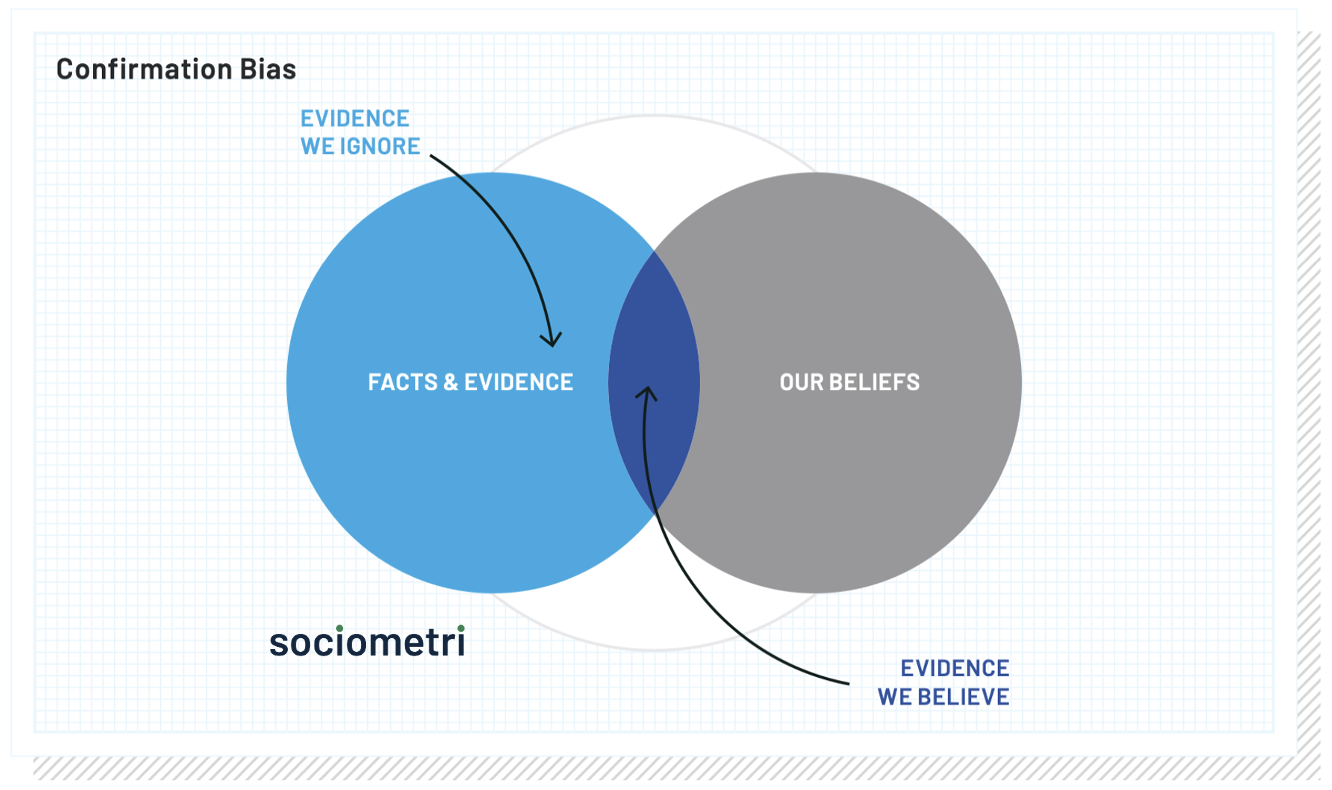
Confirmation Bias - the overlap of our beliefs + facts & evidence.
To avoid confirmation bias, it’s important to begin with an objective metric and then collectively analyze it to draw out all knowledge, insight, and evidence. Until we have collected, investigated, and corroborated all the evidence, we can’t be sure of the root cause.
The Explore phase spends a full day analyzing the problem before ultimately determining a root cause. This is time-consuming, but it saves us from creating and implementing solutions that target the wrong things.
3. Priming the Brainstorm
It’s important to prime participants to think broadly and creatively. This is done via framing.
Because we want participants to brainstorm relevant factors and extenuating issues, we don’t want to frame the data point with a “why” question.
Imagine I say to you, “It’s 85 degrees in here. Why?”
Your natural response would probably be something like, “Because it’s sunny out.”
But “because” statements are not ideal for brainstorming. “Because” implies a complete explanation; there are no further suggestions needed. “Because” also limits a conversation by committing the speaker to an explanation way too early.3
I’ve seen participants spend an hour and a half defending a “because” idea they considered for only five seconds.
Additionally, “why” sounds accusatory, often leading participants to feel defensive rather than open to thinking creatively.
If I say to my children, “Why is the refrigerator door wide open?” they will respond, “It wasn’t me!” and start accusing each other of intentional cruelty to chilled food and providing me with detailed alibis.
Their only thought is, avoid trouble! That is a terrible condition for brainstorming. We need brains that are feeling curious, not defensive.
Instead of “why,” choose a frame like: How did we get here? What are the circumstances surrounding this? When we first noticed this, what else was going on? These questions orient participants to a thoughtful, contextual analysis rather than an explanation.
One week before the workshop begins, you will send an email to participants informing them of the topic of the workshop along with a frame. For example, “At the upcoming DELTA Workshop, we will be brainstorming about the following topic: 86 percent of employees have reported that work conflict distracts them from their job. How did we get here?”
Additionally, you will ask participants to share the workshop topic, discuss it with as many coworkers as they can, and be ready to present their own thoughts as well as their coworkers’ thoughts at the workshop.
These instructions give participants time to consider the topic before the session, enabling the group to get deeper into analysis, faster. It also encourages workplace conversations about the safety ecosystem.
Lastly, setting the expectation that participants will come with multiple ideas — some of which are theirs, some of which aren’t — reduces defensiveness around the ideas.
4. DELTA Workshop Rules
Another priming tactic is to begin the Explore session with the DELTA Workshop Rules.
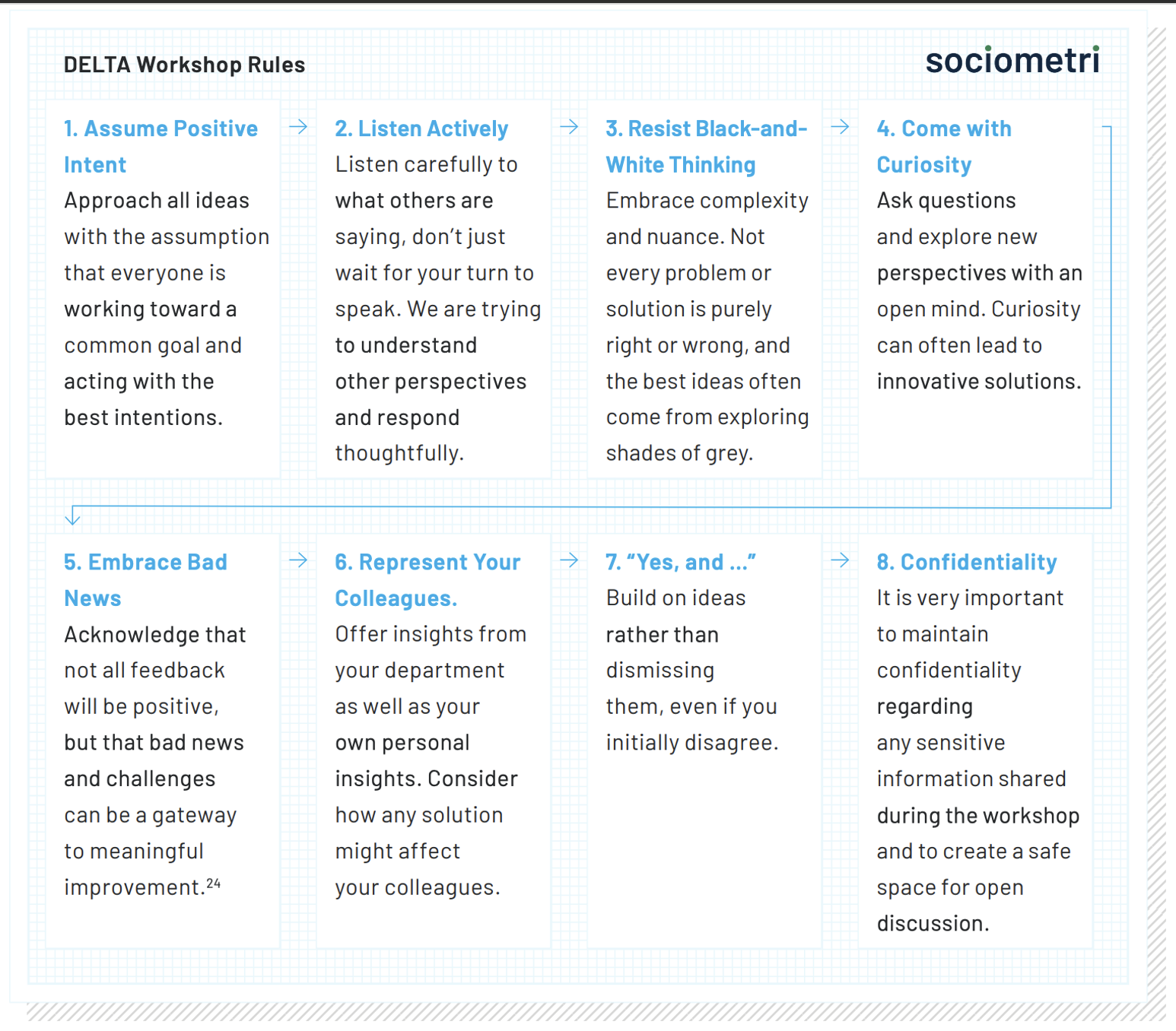
Setting expectations about how the group will approach the sessions and interact with each other is crucial for positive collaboration. After some trial and error, we arrived at our best practice workshop rules, listed below.
DELTA Workshop Rules
DELTA Workshop Rules
Assume Positive Intent. Approach all ideas with the assumption that everyone is working toward a common goal and acting with the best intentions.
Listen Actively. Listen carefully to what others are saying, don’t just wait for your turn to speak. We are trying to understand other perspectives and respond thoughtfully.
Resist Black-and-White Thinking. Embrace complexity and nuance. Not every problem or solution is purely right or wrong, and the best ideas often come from exploring shades of grey.
Come with Curiosity. Ask questions and explore new perspectives with an open mind. Curiosity can often lead to innovative solutions.
Embrace Bad News. Acknowledge that not all feedback will be positive, but that bad news and challenges can be a gateway to meaningful improvement.4
Represent Your Colleagues. Offer insights from your department as well as your own personal insights. Consider how any solution might affect your colleagues.
“Yes, and…”. Build on ideas rather than dismissing them, even if you initially disagree.
Confidentiality. It is very important to maintain confidentiality regarding any sensitive information shared during the workshop and to create a safe space for open discussion.
5. Summary
The Explore phase is an essential part of solution-finding, serving as the foundation for identifying the causes of a problem. Encouraging broad brainstorming and collective analysis helps to overcome personal biases and ensure that potential contributing factors aren’t overlooked. Using objective data, framing questions carefully, and setting clear expectations prompts participants to think creatively and collaboratively, leading to more accurate identification of root causes.
The next step is Locate, during which your facilitation team performs a thematic analysis on the ideas generated in Explore. Thematic analysis can seem daunting the first time, but in the next post we’ll break it down into simple steps that any team can work through.
--
References
1. Etienne Wenger, Communities of Practice: Learning, Meaning, and Identity (Cambridge University Press, 1998).
2. Michael W. Eysenck and Mark T. Keane, Cognitive Psychology: A Student’s Handbook, 7th ed. (Psychology Press, 2015).
3. Kerry Patterson, Joseph Grenny, Ron McMillan, and Al Switzler, Crucial Conversations: Tools for Talking When Stakes Are High, 2nd ed. (McGraw-Hill, 2012).
4. Andrew Hopkins, Safety, Culture and Risk: The Organisational Causes of Disasters (CCH Australia, 2005).